
Finishing what the foundation made possible
Building on June's sandbox runtime, July finishes the carryover: grounding the migrated agents in our own knowledge, making the chat assistant trustworthy enough to launch, and metering every action with per-action credit tracking.
Overview
next · laterJuly spends what June built. With the agents on an isolated, traced sandbox runtime, the three themes that ride on that foundation can land - grounding the agents in the knowledge base, launching the chat assistant, and metering every action with per-action credit tracking that reconciles into the Stripe billing system shipped in June. All three carry over from the June roadmap; this is a continuation month.
- Theme 1Asset library
- Theme 2AI chat assistant
- Theme 3Credit tracking
Asset library
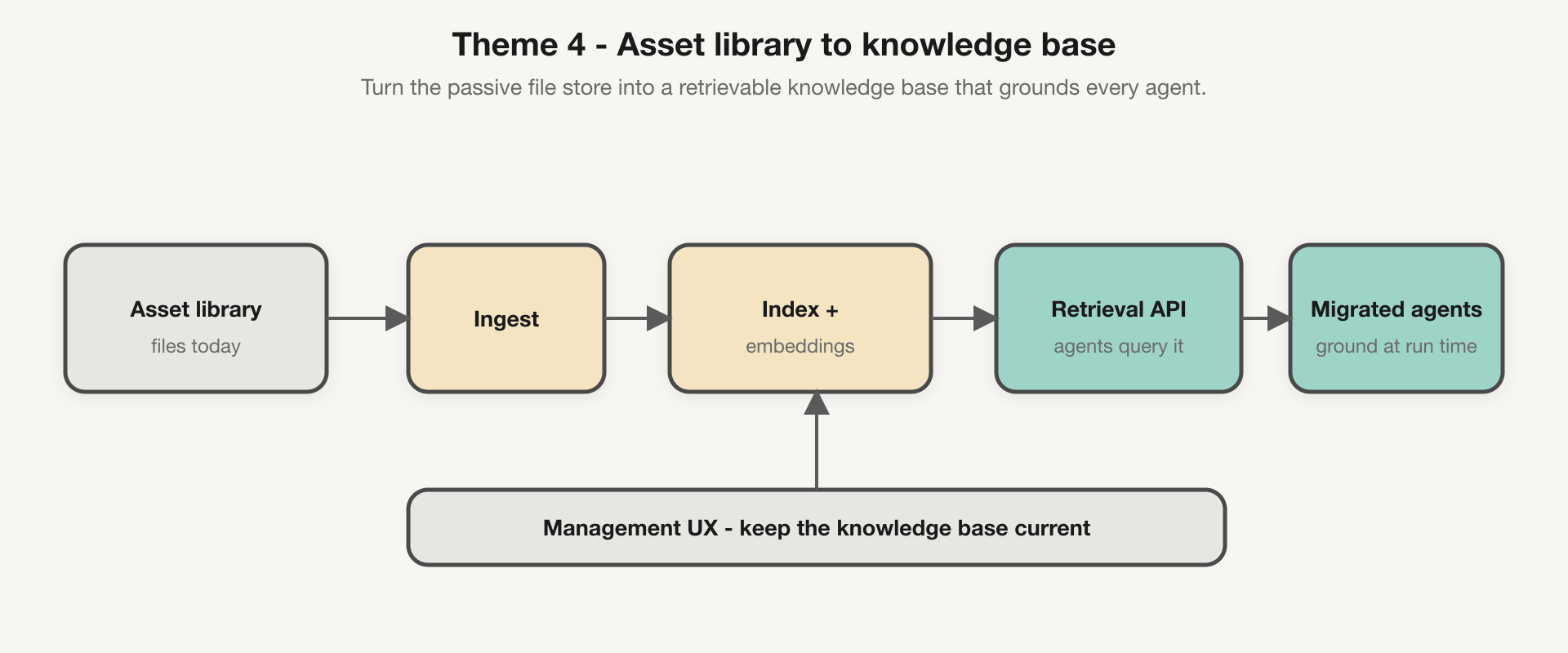
nextThe asset library today is a passive store of files - agents cannot draw on what is in it, so their output stays generic instead of grounded in our own brand voice, templates, and domain knowledge. Turning it into a real knowledge base means giving it retrieval infrastructure and wiring it into each agent as grounding context, so every agent works from the same curated source of truth. It builds directly on June’s migrated agents.
Build the knowledge-base infrastructure
Turn the asset library into a retrievable knowledge base: ingestion, indexing and embeddings, and a retrieval API the agents can query.
Wire the knowledge base into the migrated agents
Have the rebuilt agents ground on the library at run time.
Knowledge base across all agents
Generalise grounding to every migrated agent, with the management UX to keep it current.
AI chat assistant
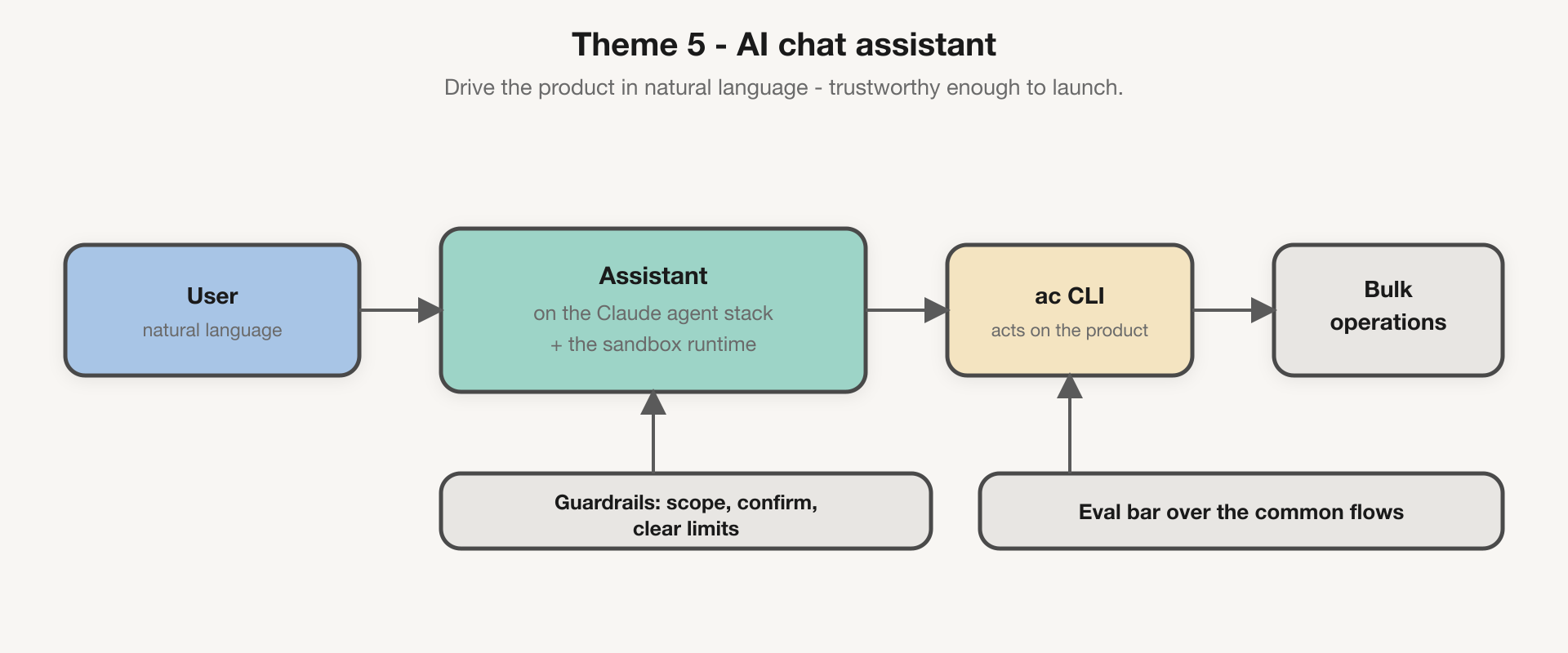
nextThe chat assistant has been in build for a while - it is the surface that lets users drive the product in natural language, including the bulk operations that are painful to click through today. What is left is what makes it trustworthy enough to launch: run it on the same Claude agent stack as everything else, let it act through the ac CLI, keep it inside guardrails, and hold it to an eval bar we trust.
Migrate the assistant to Claude agents
Move it onto the Claude agent stack and the sandbox runtime, consistent with the rest of the platform.
Give the assistant ac-cli access
Let it act across the product through the ac CLI surface, which is what makes bulk operations possible.
Add guardrails
Bound what the assistant can do and say: permission scoping, confirmation on destructive actions, and clear limits.
Improve assistant evals
Expand evals over the common flows so we can trust output quality before opening it up.
Credit tracking
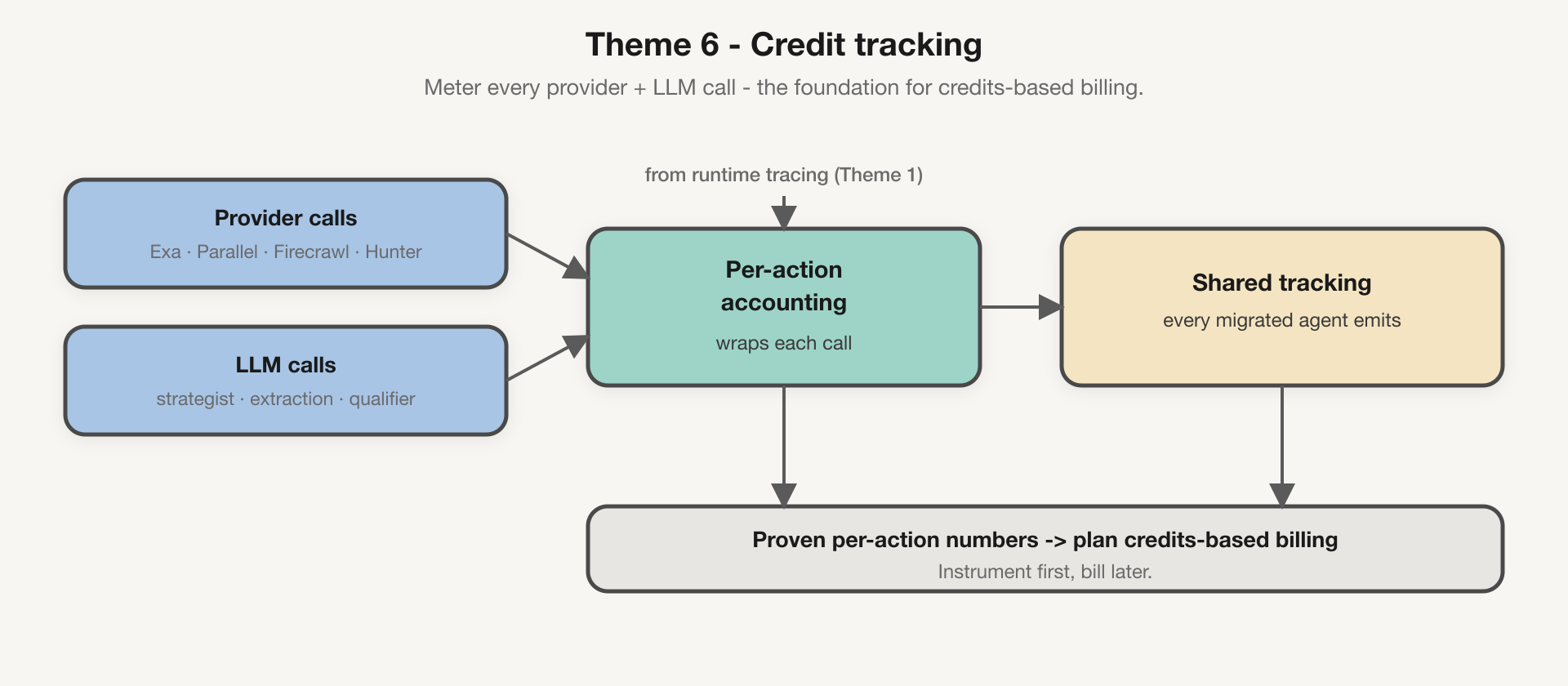
laterAccurate per-action credit accounting is what makes usage-based pricing precise. June’s runtime migration is what makes it tractable: the sandbox runtime’s telemetry is the natural seam to meter every provider and LLM call. Today only the extraction LLM calls are logged; Exa, Parallel, Firecrawl, and Hunter calls are untracked. The June Stripe billing system shipped on Stripe’s own usage records; this work makes the numbers precise and reconciles back into it.
Instrument per-action credit tracking
Wrap each provider call (Exa, Parallel, Firecrawl, Hunter) and LLM call (strategist, extraction, qualifier) with per-action accounting as the agents move onto the new runtime.
Generalise tracking, then reconcile with billing
Lift the accounting into a shared mechanism every migrated agent emits, then reconcile the proven per-action numbers back into the June Stripe billing balance. Instrument first, refine billing later.
June moved the agents onto a runtime we can isolate and trace; July spends that. The knowledge base grounds them, the assistant puts them in users’ hands, and credit tracking meters every action - reconciling into the Stripe billing system that shipped in June. The foundation pays off.