
ProductAnalytics agent
Turns event streams and feedback into product insight briefs, experiment ideas, and instrumentation gaps.
Operating brief
design targetProductAnalytics is an insight agent, not an action agent. Its first job is to make product state legible: explain behavior changes, expose instrumentation gaps, and propose experiments. Dreaming stays off until we have labeled insight quality.
Every agent uses the same loop: ingest, normalize, analyze, detect, decide, log. The useful design work is deciding what evidence enters the context, which actions exist, which actions stay dry-run, and how the ledger proves that the agent helped.
Agent design diagram
click nodesThe diagram is the high-level system boundary for this agent. Click a node below it to inspect what belongs in that layer and what should stay outside the agent.
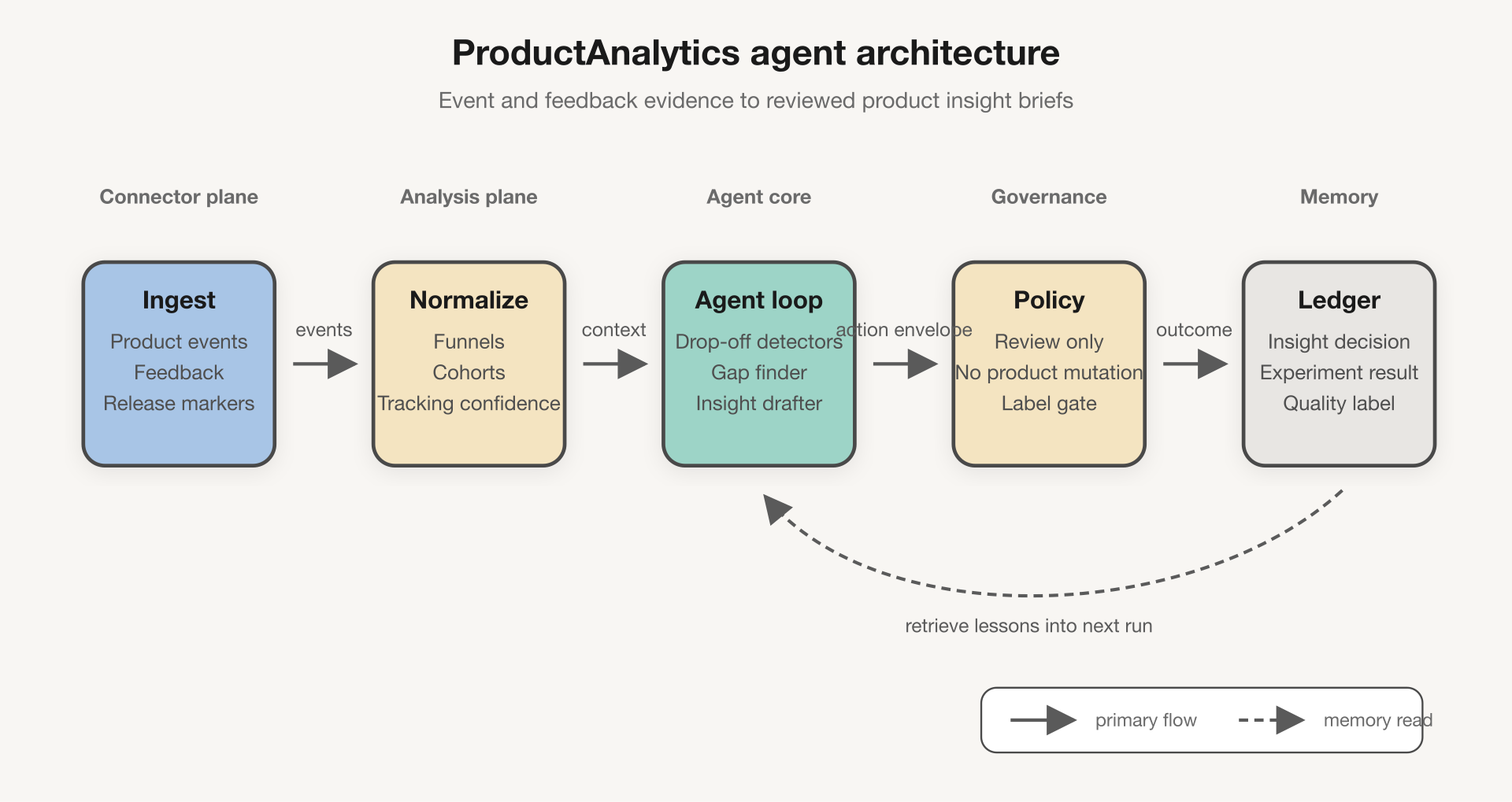
Product loop
Detect drop-offs, dead features, adoption shifts, and feedback clusters. Draft insight briefs and experiment candidates.
Signals, detectors, and outputs
design inventoryThis is the detector inventory to design first. Each detector needs a source signal, a user-visible output, and a measurement that can be written back to the ledger.
Funnel regression
- Signal
- Conversion drop by step, segment, browser, or release window.
- Output
- Likely cause brief and owner hypothesis.
- Ledger metric
- Step conversion delta and affected cohort size.
Autonomy gate
playgroundUse this as a policy-design sketch. The values are not final production thresholds; they show which classes of action should be eligible for auto-execution and which should escalate.
Keep in review
dry-runThis agent does not yet have reliable ground truth. It can draft artifacts, but learning and execution stay human-reviewed.
- Class
- Read-only synthesis
- Reversibility
- full
- Design note
- Safe to auto-create as a draft because it does not alter product state.
Context and memory design
agent envelopeResearch converges on context engineering as the quality lever: keep a stable policy prefix, put fresh evidence near the task, retrieve only relevant lessons, and expose a small tool surface.
Stable prefix
Product taxonomy, activation definitions, event naming contract, experiment policy, and what the agent is forbidden to change.
Per-run evidence
Funnel windows, cohort cuts, release markers, support snippets, feedback clusters, and instrumentation health.
Memory retrieval
Previous insights, accepted or rejected hypotheses, experiment results, and known tracking gaps.
Tool surface
Read events, query funnel, read feedback, draft insight, draft issue, propose event contract, submit policy envelope.
Evals and rollout
ship safelyBehavior checks
- Evidence-bound insightEvery claim links to event windows, feedback examples, or an explicit "unknown" marker.
- No product mutationFeature flags, experiments, and UI behavior changes are blocked in v1.
- Instrumentation honestyIf data cannot answer the question, the agent proposes instrumentation instead of inventing certainty.
- Human labelsInsight quality labels are stored separately from the agent output and gate any future dreaming loop.
Open design questions
- What event taxonomy is canonical enough to become the stable prefix?
- Where should human labels live: Linear, Mission Control ledger, or product analytics annotations?
- Which product changes, if any, can ever graduate beyond human review?
Event health map
Expose funnels, cohorts, release markers, and gaps with confidence scores.
Insight brief drafts
Generate read-only insight briefs with evidence links and missing-data markers.
Experiment proposals
Draft experiment tickets and event contracts, but keep them in review.
Label dataset
Collect human labels for useful, wrong, duplicate, and unactionable insights before enabling learning.
Research inputs
sourcesThese are the sources used to shape the page. The resulting design keeps the vendor-specific advice at the architecture level: tool surfaces, guardrails, context, orchestration, outcome logging, and domain metrics.